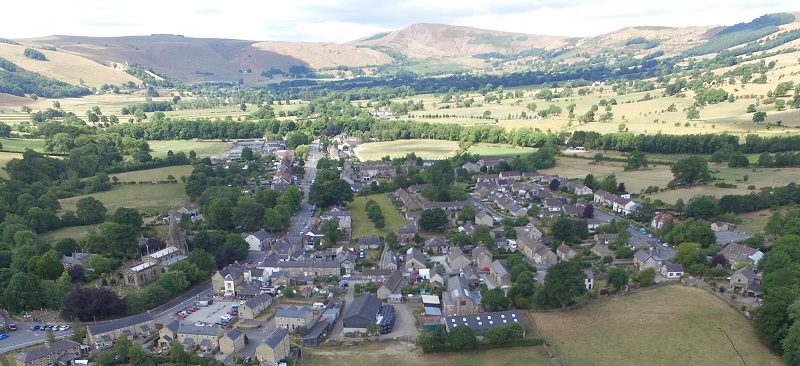
Items previously published in the parish magazine.
John Talbot
Contents List
- 1. Introduction
- 2. Death
- 3. Women
- 4. Poverty and Wealth
- 5. Livestock
- 6. Cattle
- 7. Sheep
- 8. Horses
- 9. Ploughing
- 10. Pigs and Poultry
- 11. Corn and Hay
- 12. Milk, Butter and Cheese
- 13. Wool and Wool Cloth
- 14. Flax and Hemp
- 15. Manure
- 16. Fuel
- 17. Carts and Wagons
- 18. Working Tools
- 19. Lead mining
- 20. Furniture
- 21. Beds
- 22. Tables
- 23. Stools, Chairs and Benches
- 24. Storage Furniture
- 25. Lighting
- 26. Kitchenware
- 27. Working Tools
- 28. Landownership
- 29. Debt
- 30. In Conclusion
1. Introduction
It has been a great privilege to have been able to examine the wills and inventories from the Lichfield Cathedral archives, and some from the National Archive, as part of the Lottery funded study of mediaeval life in Hope and Castleton. Although the documents begin only in 1547 in Castleton and as late as 1620 in Hope, and are therefore from an early modern period, they are revealing about rural life at a time of great political, economic and social change. I hope it will be interesting to read some of the insights and stories that have emerged.
The wills were written in a standard format, always making a pious dedication at the outset and then the most important bequest of all: the testator’s soul to Almighty God. It is only after this that they dealt with the nitty-gritty of their possessions. Wills and inventories were required by canon, that is church, law. They were concerned only with goods, chattels and “cattels”, or animals. Houses and land were a matter for the civil law and were governed by the rules of primogeniture so that the eldest son inherited all this property.
By and large, testators left their property to family members, usually following the same rules of primogeniture. Nevertheless, there are some insights into family relationships from the Hope documents.
Henry Bocking, who died in 1608, had no children but had many nieces, nephews, in-laws and godchildren, as well as other beneficiaries. Plainly he was most fond of his nephew Ralph, even though he was an unruly youth. He left him £20 on condition that he gave up gaming within four years after which “my Executors shalbe discharged of that payment.”
Testators went to great lengths to ensure their remaining relatives were housed safely after their death. Usually this was a simple matter of settling their wives and children but Nicholas Hadfield , who died in 1636, declared that his wife Margret and nephew John should live together. One hopes this was a happy outcome.
Ottiwell Smith , who died in 1638, mentioned neither a wife nor children in his will, but left £30 to Marie Gibson his servant and a sheep each to unnamed “servantmen”. The implication seems clear.
These glimpses into history stimulate lively speculation about the lives of our ancestors.
2. Death.
Why did they die?
In the popular imagination the streets of sixteenth and seventeenth century villages and towns were littered with people dying horribly from plague. The archives from Hope and Castleton do not tell us a great deal to counter this impression, but there is some information to throw light on the issue.
The wills from 1547-1650 show that, not surprisingly, more people died in February and March than at other times of the year. Why was this? Most people lived at or below subsistence level. Nationally, in the Tudor period, there was starvation roughly every four years with the worst famine in 1594 after four years of poor crop yields. Late winter and spring were notoriously the leanest times of year, the so-called hungry gap. Added to this, winter temperatures were particularly low in the early seventeenth century. There is no doubt that many died every year from starvation and cold.
Examination of the Hope Parish register of deaths shows there were several years when there were spikes in the death rate. In most years there were 30-40 deaths but in 1624 the rate doubled. This coincided with a similar rise in death rates around the north-west of the country, known to be caused by a drop in the price of wool together with a steep rise in the price of grain over the previous two years. Starvation was again the likely cause.
The next terrible year was 1636 when, again, the death rate nearly doubled. The Parish Records noted that there “…beganne the great death of many children & others by a contagious disease called the childrens pocke: & Purple Pocke: & whyt hives with blysters”. This probably describes smallpox but an epidemic of meningococcal meningitis cannot be excluded, particularly as children were prominently affected.
There were no records of plague in these villages. It predominantly affected towns: Chesterfield in 1586 and Derby in 1646, despite the appalling experience in Eyam in 1665. However, everyone was affected by these epidemics as the access to markets and employment was severely affected.
Other more mysterious causes included the sweating sickness, probably influenza, and gastroenteritis. There was another spike in the death rate in 1617, perhaps from one of these causes.
Many records are missing. We have little understanding of people’s age when they died. It emphasises how important it is to preserve our archives.
3. Women
4. Poverty and Wealth
The Lottery funded project in the Hope Valley was intended to throw light on ordinary people. Studies of the wills and inventories from 1547-1650 illuminate something of ordinary lives but often in a negative way.
Inventories were required if the estate was worth £5 or more, and did not deal with houses and land holdings but goods, chattels and animals. Although there were 6 inventories whose worth was less than £5, the owners formed only a tiny proportion of the numbers known to have died in the period. The Parish Records in Hope from 1620-1650 recorded that 687 people died, and this despite the fact that in this period 19 years are missing from the record. Yet we have documents from only 28 people during this time. Who were the rest?
We must conclude that they were too poor to have personal records. The High Peak was one of the poorest areas in the country. A tourist would have seen an industrial landscape, with evidence of lead mining and smelting wherever he looked. Although the inventories show that farming was a universal occupation for the testators, with only the Castleton schoolmaster having no livestock, this was presumably not the case for the majority. Miners made and possessed very little, even though the district was a magnet for impoverished men seeking to make a living underground.
Of the 105 people of Hope and Castleton that left documents, there was only one recorded miner and another 5 that possessed lead or lead ore at his death. The division between those mining lead and the rest seems clear.
Nevertheless, it is interesting to read those inventories that are available. Edward Spencer, who died in Hope in 1629, had an inventory valued at only £4 6s 0d and owned a mare, furniture with chairs and cushions and 2 “boards” or table tops, a cart, saddle and yoke, and various bits of iron ware with pewter and brass. In contrast, Roger Harrison was valued in 1614 at £300 15s 2d, including his debts. He owned sheep, horses, oxen with other cattle and a large quantity or oats and barley, as well as wool and yarn. In his house, he had luxuries such as an hour glass, a mirror and a “venice” glass. Imagination lets us speculate what a local miner would think about either of these two men.
5. Livestock
As has been noted already, the wills and inventories of people from 1547-1650 give surprisingly little insight into the prominent industry of the region: lead mining. But the documents do demonstrate a thriving agricultural environment.
90% of those that had enough goods and chattels to be recorded in an inventory owned livestock, and a few more had poultry. All classes of people had animals: gentry, yeomen and husbandmen, together with those whose status was not declared and who were presumably labourers. The vicar of Castleton, Edmund Goldsmyth who died in1547, owned 4 oxen, 13 cattle, 43 sheep and 5 horses and his successor, Thomas Savage, dying in 1590, had 12 cattle, 2 horses and 2 pigs. Richard Slack, the Castleton schoolmaster who died in 1581, had 2 oxen and 14 sheep. The Hallams or Halloms, the Castleton blacksmiths, owned sufficient cattle, sheep and horses to require both agricultural skills and time away from their smithy.
Single women, mostly widows, usually had a cow and some poultry, although two owned small flocks of sheep. These two were Jane Savage, who died in 1604 and had the wealthiest inventory of all, and Catherine Hallam, possibly from the blacksmith family, who died in 1610.
Husbandry at the time relied a good deal on common rights. Husbandmen would have rented land for grazing or arable production. In the latter case, they would have had common grazing rights on the stubble after harvesting, which had the additional benefit of fertilising the land. Further to that, there were rights of common grazing in the uplands. These rights became highly contentious during the enclosure movement prevalent at this period. In the High Peak there were such extensive common lands that it was not generally as much a source of grievance as elsewhere, but landlords at this time were tending to enclose land so that they could exert more control over it, particularly to increase the land available for sheep and the immensely valuable wool crop.
In the High Peak, the conditions were insufficient for large scale animal husbandry from birth to slaughter. The trend was to produce store sheep and cattle that were bred to a point that they could be sold for fattening on better land.
Nevertheless, despite these strictures, as will be seen in future articles, cattle were kept for milk, butter and cheese, and there were several inventories listing wool.
6. Cattle
Most people with wills and inventories recorded between 1547 and 1650 owned livestock. Perhaps surprisingly, the most frequently held animals were cattle. 88% had cows or calves and 30% had oxen or bullocks.
These animals were not described in the documents but it is known that the common type in this region was black with large horns, and much admired by contemporary writers. Gervase Markham, in the 17th century, noted that a good milker should have “a crumpled horn, a thin neck, a hairy dewlap” and a large white udder.
Predictably, more cattle were owned by those with relatively wealthy inventories. Usually the herd was small, with a maximum of 16. Only 10 had more than 10 cattle, whereas 16 had only one or two and the numbers held were steady throughout the period. These figures were consistent with national surveys. Their value rose through the hundred years in line with general inflation from around £0.16.0 in 1547 to £2.10.0 in 1650.
Oxen were castrated bulls, notable for their great strength and docility. By the time of this survey, oxen were beginning to be supplanted by horses for ploughing and as draught animals. Contemporary roads were very poor and wagons required great pulling power. Often, in the winter, they were impassable. In this area, there is minor evidence of old ridge-and-furrow ploughing on the landscape, as the ground is relatively light. This old technique was particularly valuable in heavy, wet ground where deep ploughing allowed better water drainage.
Oxen were owned by the relatively wealthy testators. They were probably shared within the community and it is notable that two Castleton vicars had them in their inventories; it might be imagined they felt it was their duty to provide this service to their parishioners. They were the most valuable of all animals, ranging from £1.0.6 to £5.0.0 from the beginning to the end of the period. However, even though they kept their worth in line with inflation, the numbers dropped sharply, with 40% fewer in the 17th compared to the second half of the 16th century.
Milking and the manufacture of butter and cheese was women’s work. Only 8 “milke basens” were recorded although milking must have been a universal task. Butter and cheese were always found together in inventories, but were listed only 3 times.
7. Sheep
The wool industry was the most important economic driver in this country in the 16th century. Under the first Tudor king, Henry VII, 90% of our exports were wool or wool cloth. Of these two, cloth formed 92% and raw wool only 8%, a reversal of the position in the fourteenth century.
It is therefore surprising that, in the Wills and Inventories from 1547 to 1650, slightly fewer owned sheep than cattle, at 83% of testators. Furthermore, the number of local sheep owners dropped by 25% once the Stuarts came to the throne in 1603, as a result of a change in international markets and agricultural policy. The number of sheep that people owned ranged between 2 and 200, with only 8 possessing less than ten.
In common with the practice of cattle farming, most sheep in this area were brought to a certain point in their husbandry before being sold off for fattening. Nevertheless, mutton from upland regions was generally regarded as particularly good to eat. It is hard to gauge how important the wool trade was for the local economy. Only 13 inventories listed wool, often in large quantities, up to 20 stone (127 kilograms), especially amongst those with large flocks.
It is difficult to know precisely what sheep of the period looked like. The general view is that in the Pennines they were horned and black faced. The evidence from analysis of parchment, which often contained wool fibres, was that sheep were selectively bred for increasing length of the fleece. Barnaby Googe, writing in 1614, averred that “the necke must be long, the belly large, the legges short … and … deepe woolled, and thicke all over the bodie”. It was important that the ram’s “tongue be not blacke, nor peckled, for commonly such will get blacke and pyed Lambes.” Furthermore, “The Ram must have his hornes great, winding inward, and bending to the face … In cold and stormie countries, the horned Rams are best … whereby they may defend their heads from storme and tempest”.
Sheep were important more widely as they were put out to manure the fields after harvest. Bishop Hugh Latimer, who owned sheep, wrote: “A ploughland must have sheep; yea, they must have sheep to help fat the ground; for if they have no sheep to help fat the ground, they shall have but bare corn and thin”.
8. Horses
Until it is remembered that they were the only means of transport in the period 1547 – 1650 as recorded in Wills and Inventories, it may be a surprise that 72% of the documents listed horses. After all, men and women from Hope and Castleton were far from wealthy. Of these 62 people, 20 listed only one horse, with a maximum of 6 in one inventory.
Frustratingly, there are few indications as to the breed or even function of the horses, whether they were beasts of burden, for pulling the plough, or for riding. However, inventories did list 11 pack saddles, 4 cart saddles, 3 hackney saddles and one side saddle. The hackney horse was for riding, and the side saddle belonged to the wealthiest inventory, that of Jane Savage from Castleton, who died in 1604.
By this time, horses were supplanting oxen for ploughing and pulling heavy loads, although some contemporary writers firmly opposed this trend. Fitzherbert, writing in 1534, noted that “the ploughe of oxen is moche more profytable than the ploughe of horses” and then listed many disadvantages of horses, even concluding that at the end of the animal’s life the horse was “but caryen”, unlike oxen which became “mannes meate, and as good or better than ever he was.” Gervase Markham, in 1613, noted that plough teams could consist of both horses and oxen.
The Rev. William Harrison, writing in Hollinshed’s ‘Chronicles’ in 1577, claimed that English draught horses “are commonly so strong that fyve (or six) of them (at the most) will draw three thousand weight” or 1½ tons.
Whilst there are few clues as to the horses’ breeds, active development of horses was taking place by this time. As noted, the hackney horse was widely used for riding, although it was smaller than modern animals. The Suffolk Punch had also been selectively bred by this time. Markham, in 1617, recommended that the best horses for husbandmen came from “Freeseland, Holland, and Artoys”. However, working horses in the Derbyshire lead mines were probably bred in Lincolnshire.
Horses in these inventories rose in value throughout the period by a multiple of 3½, the greatest inflation in price for any animal except pigs. The rise from £2 to £3 10s (£3.50) was particularly marked in the last decade, the 1640s, when suddenly they became strategically essential during the Civil War.
9. Ploughing
In our exploration of the wills and inventories from 1547 to 1650 we have seen that oxen and horses were included in many documents, with oxen persisting as draught animals longer than in some parts of the country. Some authorities believe that, in upland areas, these animals were used mostly for pulling carts and wagons and for carrying heavy loads but here there is clear evidence that they were used for ploughing as well.
Six men, mostly in the upper range of inventory valuations, owned ploughs, although Thurstan Hall from Castleton was worth only £3 2s 6d (£3.13) at death. Early inventories did not usually list chattels and the earliest mention of a plough was in 1596. There were 7 yokes and 3 teams, or harnesses for attaching to a cart or plough.
Nowadays there is little evidence of historic ploughing in the area, although there is some ridge and furrow field marking near Hathersage. Without doubt, however, the valley bottoms at least would have been ploughed.
In the agricultural cycle of the time, land was left fallow for a variable length of time, depending on local conditions. Here, there might have been 2 to 4 years of arable, followed by up to 8 years of grass cultivation or “leys”. Ploughing had three functions: to break up the soil, to bury manure and to assist drainage. Ploughing fallow land usually took place in winter and was followed by three or four further ploughings in a year. If it was to be returned to arable, ploughed soil was harrowed or broken up with mattocks. Eighteen inventories included harrows.
Light soil was ploughed in two directions at right-angles, leaving no permanent mark on the landscape. Heavy soils required a strategy to facilitate water drainage. The land was ploughed in elongated ovals, starting in the middle and building up a ridge as the plough team worked to and fro around the oval. This created a ridge and furrow pattern. The ridges were orientated up and down any available slope so that water could drain into the furrows and be channelled away. They frequently had an S-shape, reflecting the distance needed for an ox team to turn. In subsequent ploughings, the farmer could either flatten the pattern of ridges and create new ones, or, in water-logged land, might emphasise the ridges, giving rise to the persistent pattern familiar today.
10. Pigs and Poultry
Pigs, always known at the time as swine, and poultry were occasional items in the inventories from 1547 – 1650.
Swine, never more than 3, were listed 20 times. This is surprising as pigs not only provided a source of protein and calories but also excellent leather. They could be kept on poor land and their meat was easier to preserve than beef or mutton. They were never worth a great deal, inflating from £0.3.0 to £0.12.6 (£0.15 – £0.65) during this period, in line with the rise in value of sheep.
The problem was the difficulty of overwintering them. Fitzherbert, in 1534, noted that “they cannot be rered in winter, for cold, without great coste.” Traditionally, swine were put out to pannage in the autumn, a mediaeval custom in which the animals were turned out into woodland from August to December to eat acorns and beech mast. The damage to oak woodland, now becoming a strategic asset for ship building as Britain’s sea power increased, caused Henry VIII to restrict this right. Perhaps in this period there was little pannage in the Hope Valley but, in any case, pigs were becoming more domesticated and useful farmyard scavengers. At around this time, improved nutrition and breeding permitted a cycle of farrowing to slaughter in a single year.
Swine of the period were not the large lop-eared animals with which we are familiar, but smaller, prick-eared and bristly. Pig husbandry later became commoner with the importation of an animal that was larger, fatter and with access to potatoes.
Poultry were listed in only 19 inventories, but there is the suspicion that they were more widely kept but not listed as they were of little value. Of the “feathered cattell” only chickens and geese were recorded here. Geese were regarded as easy to keep and Barnaby Googe, in 1614, noted that they were “more watchfull then the Dogges.” Googe gave much advice about the proper selection of chickens, noting in particular that white birds “are commonly tender, and prosper not, neither are they beside fruitfull, and are always the fairest marke in a Hawke, or a Bussards eye.”
All the writers of the period reckoned they were good animals for women to own, Googe saying: “the poorest widdowe in the Countrie is able to keepe them.” Here, only 3 of the 19 inventories with poultry were from women.
11. Corn and Hay
One of the most frequently listed items, seen 43 times, in the Wills and Inventories of 1547 – 1650 is “Corn and Hay”, usually together. We have to assume these terms meant the same as they do today.
In well favoured areas, hay was grown in rich, lowland wetland meadows, fertilised by grazing animals. In uplands, however, the quality of this essential crop for overwintering animals was less and would have had priority over other crops.
Corn meant edible grain, both fodder and for human consumption. It is estimated that around 20% of grain grown nationally was for fodder. The Derbyshire Justices reported in 1620 that the county grew less than half its needs, and as a consequence grain was imported and tended to be expensive. The Justices sometimes had to intervene in the market to ensure adequate supplies although occasionally, for instance in 1631, there was a glut.
In 1613, Gervase Markham identified 6 varieties of wheat, 2 of rye, 3 of barley and 4 of oats but only one inventory here itemised wheat. Barnaby Googe in 1614 noted that: “wheat delighteth in a levell, rich, warme, and a dry ground: a shadowed, weedy, and a hilly ground, it loveth not” . Generally at this time wheat was not available to labouring people.
Barley was the most valued crop after wheat although only included in 5 inventories. Of the several varieties available, six-rowed barley, or bigg, was the worst but could be grown on dry, poor soils and was known to be prevalent in several northern counties.
Oats were the principal cereal component of the diet on the poor, wet soils of the north and west of the country but were a fodder crop elsewhere. They were the predominant crop in the High Peak. In these documents, oats in one form or another – grain, thraves (12 sheaves), or meal – were listed 7 times.
Meal or ground grain, malt or dried germinated grain, usually barley, and grain itself were included in 15 inventories. The usual unit of measurement was the bushel, hoop or strike, equalling 8 gallons of dry goods, or 4 pecks.
Very little information regarding local grain or hay prices can be gained from these documents but, in Derbyshire as a whole, wheat prices in the period 1538 – 1622 inflated by about 6 times, barley 6.5 times and oats 7 times.
12. Milk, Butter and Cheese
We have seen already that there were more cattle than any other animal in inventories from the period 1547 – 1650. Surprisingly, therefore, very few listed equipment for milking or for making butter or cheese. Thomas Marshall from Castleton, who died in 1649, listed “8 milke basens” and only three inventories contained butter and cheese, always together. The likelihood is that its production was such a routine task, allotted to women, that the equipment was not regarded as worth listing, or that other vessels in inventories were used for the purpose but not specifically named as such. In this context, it is worth noting that 2 of the 7 widows with inventories owned a single cow which must have been for their milk.
Gervase Markham, in his 1635 book “The English Housewife” devoted pages to milking. It is noteworthy that he insisted that hygiene in the dairy was essential: “not the least mote of any filth by any means appear.” The same applied to the containers “which must be scalded once a day … and set in the open air to sweeten.” Milk was routinely “siled” or sieved through a “very clean washed fine linen cloth.” Barnaby Googe in 1614 reckoned that the best milk came from goats which was “the most comfortable to the stomacke” but no goats appeared in any of these documents. He added that “sheep’s Milke is sweeter, and nourisheth more, but is not so good for the stomacke, by reason it is fatter and grosser.”
Cream could not be kept for longer than two days in the summer, and four in the winter. The cream had to be churned for butter, and Markham gave specific advice as to timing, to fit with usual market days.
Rennet was needed for making cheese, and there were lengthy instructions as to how to make a rennet bag from the stomach of a suckling calf. In Markham’s opinion, the best cheese was “morning cheese” made from that morning’s milk together with cream from the evening before. He also recommended “nettle cheese” as the “finest summer cheese which can be eaten” He described “eddish cheese” made from milk from cows fed on the eddish or grass that grew after the harvest. As it was produced in winter and could not be dried and hardened in the warmth of summer, it was a soft cheese.
13. Wool and Wool Cloth
Wool was by far the most important commodity this country produced in the late mediaeval and early Tudor periods. By the 13th century, English wool was pre-eminent in European trading. In Henry VIII’s reign (1491 – 1547), the wool cloth trade had surpassed that of the raw material, amounting to as much as 90% of all exports. English wool was generally regarded as of the highest quality and Barnaby Googe in 1614 noted that “the best at this day is the wooll of England.” William Harrison, in 1577, observed that “strangers succoured here from domesticall persecution”, that is Huguenots, had expanded the range of cloth to “sundrie other uses, as mockados, baies, vellures, grograines, etc.” The trade suffered with a general collapse of the continental market in wool, and the loss of Calais, which was an important entry point into Europe, in 1558. Thereafter, wool prices did not rise as much as those of other commodities and many husbandmen and farmers suffered greatly if there was a collapse in the price as in 1624, which was attended by starvation and a doubling of mortality nationally, and reflected also in the deaths registered in Hope. In the 17th century, protectionist policies attempted to remedy the position but other textiles began to be imported and the wool trade gradually lost its importance.
In the inventories for 1547 – 1650, 83% listed sheep and 13 recorded wool. As might be expected, the largest holdings were in the inventories of those with the most sheep. Woollen cloth was mentioned 21 times in wills and inventories, sometimes with several different categories in the same document: 9 wool, of which one was kersey, a particularly high quality material, 3 green and 3 russet, and 6 unspecified cloth (which may have been made of linen or other material). Googe recorded that shearers “do commonly appoint for their season the tenth of the Moneth of June.” Once the sheep had been sheared, the husbandman’s responsibilities for the wool ended and the housewife took over. She had to clean it and toze (tease) it by hand before it could be dyed. The wool had to be carded and then he insisted that the wool was oiled with rape seed oil or goose or even swine fat so that it “draw well” on the spinning wheel. “The housewife hath finished her labour” by this stage
14. Flax and Hemp
Hemp, from the stem of the plant Cannabis sativa, was used for sacking and work clothes. Hemp was grown widely on a small scale, often close to habitations, and its gathering and preparation provided welcome employment after the harvest of main crops. It was also used in sail and rope manufacture and, therefore, of strategic importance.
In the Wills and Inventories of 1547-1650, there were only 3 inclusions of hemp or hemp fibre from the two villages, although there were several from surrounding hamlets.
Flax is from the linseed plant, Linum usitatissimum, and, like hemp, is extracted from the stem. There were 9 mentions of flax, 15 of “linnen” and one of “hardin” (harden) cloth, a material coarser than linen. Of the linen, in some cases the term was clearly in the context of napery and sheets, but 4 listed bolts of cloth between 2½ and 25 yards in length, and 2 others included yarn. Although flax alone is now the raw material for making linen, in 1623 Gervase Markham noted that “linen cloth, whether it be of hemp of flax, … from those two only is the most principal cloth derived…”
Markham advised growing them both in the same conditions as barley. “It must be pulled up by the roots, and not cut as corn is…” usually in July unless seed was to be preserved.
The preparation of both flax and hemp fibre was exhaustive. An essential component was washing in running water in bundles or “beats” then rotted or “retted” in still water to separate the fibres, before drying. Hemp was poisonous to fish and this had to be considered when choosing the best place for washing. Flax required a week of drying before beating and retting. The stems were then broken down with a “brake” but only after thorough drying. This process was very dangerous if, in damp seasons, a kiln was used. Finally a “swingle tree” was used repeatedly to break the fibres down further, followed by heckling or combing, until the required fineness was achieved. The best linen also needed rolling and plaiting before beating again and bleaching in ashes and lye before it could be woven.
It must be remembered that these tasks were expected of women, in addition to other work, much of it coinciding with a particularly heavy schedule in the seasonal agricultural cycle.
15. Manure
It may seem strange to relate that manure, or “meaner” as it was usually called, was important enough to be recorded in inventories from 1547-1650. Although it was not valuable in monetary terms, 12 appraisers saw fit to list it. The range of values was only 12 pence to 10 shillings, presumably dependent on quantity, which was never specified.
The science of fertilisers was unknown at this time but it was recognised that additives improved soil fertility and productivity. The number of bushels per acre of corn increased by around 100% between the 13th and the 16th centuries.
Barnaby Googe graded manure in 1614: “The first of Poultry, the next of Men, the third of Cattell”. Human waste had to be mixed with household rubbish, otherwise it was “too hot, and burnes the ground.” Urine was kept for six months before being used on vines and apple trees when it “bringeth great fruitfulness to the trees, and giveth a pleasant taste to the fruit.” In 1534, Fitzherbert preferred cow dung to that of horses whilst noting that doves’ dung was the best “but it must be layde upon the grounde verye thynne.” Others agreed that “Pigion or Pullen-dung”, but specifically excluding goose dung, “… is the best of all other”.
Googe noted that “the dung that hath line a yeere, is best for Corne, for it both is of sufficient strength, and breedeth lesse weeds”.
It is possible that the term “manure” included other soil conditioners such as wood ash, lime and marl, which is a mudstone containing lime. In 1613, Gervase Markham noted that “if you finde this soile to be subiect to extraordinary wet and coldnesse, you shall then know that the ashes eyther of wood, coale, or straw, is a very good manure for it”. Further, “if then you take Lime and sow it upon your land … and then sow your corne after it, you shall finde great profit to come thereon.” Importantly, he also said “…pulses, which both bring forth commoditie, and also out of their owne natures doe manure and inrich your ground, making it more apt and fit to receive much better Seede”. The importance of nitrogen fixing legumes such as clover in crop rotations was not fully recognised until after 1650, although clover had been imported from the Low Countries as early as 1620.
16. Fuel
It would be surprising if we saw listings of wood and coal in a modern inventory. However, at the time of the Wills and Inventories from 1547 to 1650, keeping warm and cooking were high priority challenges. Nine inventories listed fuel, rarely by itself and often combined with peat and manure in the valuation, suggesting that peat was not the only fuel and wood played an important role as well.
The recommended month to lay in wood was May. In 1534, Fitzherbert observed: “For than the waye is lyke to be fayre and drye, and the days longe, and that tyme the husbande hath leeste to doo in husbandry”. However he also suggested that trees should be lopped in winter so that “thy beastes maye eat the brouse, and the mosse of the bowes”.
Two listed coal. Coal was collected where it was found on the surface; just beyond the Hope Valley it was plentiful. At this time, primitive chimneys meant that coal burned poorly, producing dangerous fumes.
Peat was an essential fuel at this period of intense cold and was extracted and burned in huge quantities. In the fourteenth century, 34 million cubic metres were cut in the South Pennines. The amount burned by a household was between 5,000 and 12,000 turves per year and a peat stack could be as big as the cottage that would consume it. The calorific value of peat was one sixth of that of coal. Peat cutting was undertaken in a farm’s enclosed area, or hey, on the moorland above the cultivated part of the farmstead and pastures, or, for some farms, in unenclosed areas. The peat cuts and sledways are still visible in the landscape.
For an area that traditionally used peat for fuel, therefore, it is surprising that only 4 had it listed in their inventories. However, there were a further 4 with peat spades and 2 with peat carts. Only one sled was mentioned.
Porter, in 1923, wrote about the ‘Crookstone Peat and Stone Pits’ charity in Hope. Founded in 1691, it was based on land bounded by Henry Balguy’s: “The part of Crooksden is 160 statute acres besides 8 acres for slate and 40 acres for free stone and peats.” In 1711, “the tenants and freeholders of Hope aforesaid have liberty to dig get and carry away peats to burn in their houses in Hope aforesaid.”
17. Carts and Wagons
Listed in Hope and Castleton inventories from 1547-1650, there were 31 with carts that had 2 wheels, and 6 wains, that probably had four. The wain was a wagon, although there is some doubt as to the difference. Some inventories indicated that carts could have differing functions: dung carts or peat carts for instance.
In 1534, Fitzherbert emphasised the husbandman’s need for a “wayne”, made of oak, to “lode his corne”. He also described carts which were made of ash “bycause it is lyghte”. Wains and carts might have had “carte-ladders bothe behynde and before”. The carrying capacity of a cart or wagon could be increased by the use of side boards and, starting in the mediaeval period, ladders that extended in front of and behind the body of the vehicle. At first carts had a simple pole for pulling, probably by oxen. Later, they had a pair of shafts as horses became the draught animals of choice. The top was wider than the bottom to accommodate bigger loads and the back wider than the front to make unloading easier. Some were designed to tip. Their carrying capacity was up to around one ton .
The wagon developed in England in response to the change in agricultural practice away from subsistence farming to growing for the market. The number of vehicles on the roads increased, as did the distance travelled and the need for heavy wagons. By the end of the seventeenth century they could carry up to eight tons, requiring as many as 12 draught horses. The development in the seventeenth century of lighter vehicles that had a moveable fore-carriage or pivoted front axle, and which was therefore more manoeuvrable, allowed the use of wagons on the farm.
Wheels were listed in 30 inventories. Wheels, by this date, were spoked for lightness and strength. Fitzherbert noted: “If they be yren bounden, they are moche the better, and thoughe they be the derer at first, yet at length they be better cheape …”, although he recommended wooden tyred wheels on “marreis ground and soft ground” as they were wider. All carts and wagons caused deep ruts in the trackways and because of this the vehicles were purposely designed with a standard width between the lower point of each wheel, usually 4ft 8½in, not coincidentally the same width adopted when the railways were built
18. Working Tools
The Wills and Inventories from 1547 to 1650 listed a wide range of tools although the numbers were often surprisingly small, considering that almost every testator was involved in agriculture in one way or another. There were 31 types of tool, mostly agricultural implements but some may have been for lead mining, notably augers, sieves and pickaxes.
The commonest tools for cultivation were spades (7), pitchforks (5), shovels (5), scythes (4), and mattocks (3), along with sickles, pickaxes, crowbars, wimbles, hoes, forks and rakes. Slightly more common were axes which were listed 7 times, with 2 hatchets. A wimble was probably a tool for twisting corn into a coarse rope for tying corn sheaves. The lack of tools for turf or peat cutting is consistent with the infrequency of peat and sleds in the inventories.
Spades came in many varieties with different functions, from a straightforward delving spade to turf and peat spades. The function of a pricking spade is obscure, but possibly was used for pricking out seedlings. Spade handles were usually made from ash and the blade from iron or wood with an iron sleeve. There was considerable regional variation as to their precise form.
Tools that were used by women, particularly those used for harvesting, such as rakes, were often lightly built. They were usually made from softwood and lightened further by bevelling or rounding the wood, even though iron tines might have been used to make the tool hard-wearing. Early pitchforks were also wooden, with the end of a pole split and held open with a wedge, before being superseded by iron.
The scarcity of scythes and sickles may have reflected their low value, but it is possible that their rarity reflected a shift away from arable to pastoral farming.
Also often listed were hand tools, the commonest of which was a nogar (auger) (6), but also hammers, mallets, chisels, saws and adzes. There were four inventories with ladders and one with a wheelbarrow.
Fitzherbert in 1534 was dogmatic as to the tools a husbandman should possess: “Also an husbande must have an axe, a hatchet, a hedgyngebyll, a pyn-awgur, a rest-awgur, a flayle, a spade and a shovell.” He acknowledged that these tools might have different names around the country. He also recognised the cost of buying tools and that the husbandman should “learn to make his yokes, oxe-bowes, stooles, and all maner of plough-geare”.
19. Lead Mining
At the time of the wills and inventories from 1547-1650, North West Derbyshire was heavily industrialised and, despite the evidence here of an agrarian community, lead mining has been described as the only employment for many poor people. It is, therefore, one of the most striking facts to emerge from the study of these papers that documentary evidence of lead mining was rare.
Five left quantities of lead and the owners probably dealt in lead, or were directly concerned with mining. Only John Bramall, who died in Castleton in 1640, was identified as a miner. Thomas Bocking, who died in 1615, also from Castleton, had an estate that was owed a fooder of lead (also foother or 19½ cwt) as well as 2 debts of “dishes” of “owre”. A dish was about 65 lb. of lead ore. All the others owned, owed or were owed pieces, piggs (ingots, usually 1/8 of a foother) and spiggets of lead.
John Needham, from Castleton and dying in1615, had these items consecutively in his inventory: “One grove & meare of ground, one washinge sieve wth other toules, thertaine owre.” A grove was a lead mine and a meer was an ancient unit of length for mining a lead vein, locally 32 yards long. It could be of any width or depth. The sieve, in this context, was for sieving ore before washing or buddling. Sieving for this purpose is said to have been introduced in 1565 and was also used for scavenging small quantities of ore from spoil heaps. Needham also owned: “three kyne, one heyffer & ii Calves, three horses & mares & one fole, xxv sheepe.” The dearth of inventory items associated with mining and the almost invariable inclusion of livestock suggests that in this segment of society most led an agrarian lifestyle with only a suggestion that it was combined with mining. Documented disputes arose between miners and farmers and there is no doubt that mining coexisted with, and went on beneath, the farmers’ fields. Local Justices did not have to make provision under the Poor Laws for those employed in lead mining. These documents reflect the economy only of a relatively well-off segment of society and their number is small. The bulk of those that died, as identified in the Parish Registers, did not leave wills and inventories, and these certainly included many impoverished miners.
20. Furniture
The wills and inventories of 1547-1650, particularly in the second half of that period, included a good deal of information about the furniture in people’s houses.
It might have been hoped that these documents, as elsewhere in the country, would inform us about their houses themselves. However, here this is not the case. Even so, some suggestion as to the sizes of their houses can be extrapolated from the amount of furniture they owned. For instance, the wealthy Roger Harrison from Castleton, who died in 1614, owned 4 featherbeds as well as 6 pairs of bedstocks (bed frames), 7 coffers, 3 tables and numerous other large items. Presumably his house had not less than 4 bedrooms, at least one parlour and a dining room, probably more. John Bockinge of Hope, who died in 1630, had 2 featherbeds and furniture for at least 2 living rooms. At the other end of the scale, although she was well-off financially, Elizabeth Saunderson of Hope, who died in 1636, had a chaff bed, a coffer and a dishboard, probably in just one or two rooms.
This period saw many changes in the construction of furniture. The craft of joinery started in the late mediaeval period, whereby furniture was no longer put together with nails but with pegged mortice-and-tenon joints. Carpenters, who made the early simple furniture, were excluded from making joined furniture from 1632 onwards. Joiners had the exclusive use of glue and the right to make dovetail joints.
Turners also were separately identified through their livery company in 1604. The range of turned articles extended from treen tableware to limited varieties of furniture, especially chairs. They would have used either a treadle or a pole lathe and their work overlapped with that of wheelwrights.
Cabinet makers were joiners who constructed large pieces of box-shaped furniture, such as chests, from dovetailed boards without a jointed frame. Such work, initially introduced by immigrant craftsmen, was often lavishly decorated with veneers and marquetry.
In 1577, William Harrison noted that hitherto expensive furniture “now it is descended yet lower, even unto the inferiour artificers and manie farmers, who (by virtue of their old and not of their new leases) have (for the most part) learned also to garnish their cupboards with plate, their (ioined) beds with tapistrie and silke hangings, and their tables with (carpets &) fine naperie …”
21. Beds
Fifty seven of the inventories from 1547 to 1650 listed some form of bed or bedding, ranging from featherbeds to chaff beds, together with bedstocks or bed frames. There was one flock bed, whose mattress was made of pieces of wool. Elaborate beds were not listed in Hope and Castleton although Thomas Eyre of Highlow Hall (died 1633) had “in the whyte chamber one hye bed, & one lowe bed wth furniture thereunto belonging” and “a trindle bed wth furniture thereunto belonging in the nether parlor.” It is likely that some had no beds and they slept on the floor, and presumably this was also the fate of many of those who were too poor to have inventories.
A bedstock was a simple wooden frame with a row of holes through which a mesh of rope could be strung. Over this was laid a canvas sheet and then a mattress or rush mat. On top of this was laid the feather, flock or chaff bed. The incumbent was supported by pillows or a bolster and covered by sheets, blankets and quilts.
16 had featherbeds and, not surprisingly, these were owned by the wealthier people. Roger Harrison of Castleton (1614), whose net worth was £300.15.2, had four. Featherbeds were estimated at £1.0.0 to £1.13.4 but were often listed with mattresses, bolsters and blankets, making valuation difficult.
Chaff beds were made of waste material, or possibly straw, and were listed in 12 estates, but, of these, only 3 were listed as the only form of bed. In all the rest, other beds, sometimes only bedstocks, were also listed. Of these three there were two relatively small estates but a third belonged to Elizabeth Saunderson (1636 Hope), one of the wealthiest of all. Chaff beds also were rarely listed separately but were of low value, varying between 8 pence to 2s 8d.
There was a change in bedding with time. In 1577 William Harrison described the old ways: “… for (said they) our fathers (yea and we our selves also) have lien full oft upon straw pallets, (on rough mats) covered onlie with a sheet, under coverlets made of dagswain or hopharlots (I use their own termes), and a good round log under their heads in steed of a bolster (or a pillow)”. Dagswain was a coarse fabric or carpet made from wool refuse, and hopharlot a coarse coverlet.
22. Tables
In the inventories from 1547 to 1650, tables were surprisingly rarely listed, occurring in only 12 cases, but boards, supported by trestles, were commoner (26). Tables themselves tended to be listed in the wealthier households, although this was far from consistent, and the earliest was from 1613. It should be noted that either tables, boards or both were listed in a minority of households (35 of 72), less than items used for storage.
The trestle table was the usual type in the sixteenth century and before. The top, or board, was made from large planks held together with cross-battens underneath or made with tongue and groove joints. The trestles, or dormants, were either separate or joined by a cross rail, and usually plain, the whole construction theoretically being able to be dismantled.
It was the practice earlier for people to sit on only one side of the table, with their backs to a wall, and served from the front. The tables were often correspondingly narrow and this also explains why stools and forms were acceptable seating as people could lean against the wall. Only later, as the table moved to the centre of the room, was it necessary to provide back-stools or chairs .
The joined table started to appear around 1550, with a top that was usually fixed to the underlying frame and supported by legs that were sometimes turned and carved. In the seventeenth century, smaller tables were developed with folding leaves that took up less space when not in use. There is no hint in these inventories of any distinction between types of joined tables.
One joined table from around 1600 – 1650 has been found in Castleton. It is a side table, higher than a conventional dining table, with 33 small roundels carved in the rail along one side and confirming that it was designed to stand against a wall. It is known as an apostle table from its similarity to depictions of the table in paintings of the Last Supper, and may have been an altar, although it is too large, at 7 feet long, to have fitted into Castleton church.
Tables were sometimes covered by a boardcloth (13) or even a table carpet (1), in the latter case in one of the most luxurious homes in this series, that of Roger Harrison from Castleton, who died in 1614.
23. Stools,Chairs and Benches
In the inventories from 1547 to 1650, chairs were listed in 32 (with one back-stool in 1635), stools in 27 and forms (benches) in 20 inventories, frequently occurring together. In all, half of the households listed some form of seating.
Stools and forms were essentially of the same construction. Early stools were of a boarded type, simply made by a carpenter out of five planks of wood and held together with pegs or nails. They were superseded by joined stools in the middle of the sixteenth century and, by the next century, together with chests, were the most common items of furniture. There were often found in sets of six, although not in these documents, and together with forms and chairs were placed around a table.
Nowhere in these papers is there any description of the type of chair used. Chairs or back-stools are ancient forms of furniture but early survivors are rare, giving rise to the mistaken belief that they appeared for the first time in 1600. Early chairs were as tall as stools, to suit the height of contemporary tables, with a low front stretcher. Non-upholstered chairs appeared after 1630. The earliest mention of chairs in this series of inventories was from 1627. In the seventeenth century chairs became lower to fit under the table and often took a regional form. The Yorkshire-Derbyshire type had an open arcaded back and, in South Yorkshire, the back had crescent shaped cross splats. These types first appeared in around 1620. Cromwellian chairs were plain with an unstuffed leather cover to the seat and turned stretchers or legs; later the pattern persisted but with stuffed seats.
No great chairs or armchairs were mentioned, presumably as these were grand and expensive items of furniture, often lavishly decorated with carving. Examples can be dated to the sixteenth century.
Stools were probably always used with cushions (“cussions, cushens, cushings ” etc.). Found in 29 inventories, these were high status items. They were made of luxurious materials such as leather or woven fabric, stuffed with feathers or hair and perhaps embroidered. They were carefully listed and counted in many cases, and sometimes valued separately. The number of cushions varied with the wealth of the inventory. John Hall who died in Castleton in 1604 and whose net worth was £199.19.7 had 28, the most of any of these inventories.
24. Storage Furniture
In the wills and inventories from 1547 to 1650, furniture for storage was given priority, even among the poorer households.
Arks were found in 54 estates. Arks, named after their shape were made originally by arkwrights. They were chests with lids and hinges or which could be lifted off, and came in different sizes, as is evident from the frequent references to great and little arks. Typically the lid was domed or with canted sides and where it could be lifted off, turned upside down and fitted with poles, it could be used for carrying. The ark’s principal use was for storing grain or meal.
Chests and coffers were also common, numbering 16 and 34 respectively. Here, the terms appeared interchangeable as in no case did both occur. However, strictly a coffer was a box covered in leather, although the case was often made from cheap wood such as pine or beech. They were often elaborately decorated with gilding or nail work.
Early chests were either made of five nailed planks with a hinged lid, or of a clamped-front construction, the earliest form of joined work. In the latter, the boards of the long side of the chest were joined with tongue and groove joints and clamped between vertical boards or stiles at each end. More commonly in the second half of this study period, the chest front had vertical panels between stiles, or muntins. After 1660 these panels were sometimes chamfered. The panels, rails and muntins were often decorated.
Less common were aumbries (in 3), presses (1) and cupboards (11) probably also signifying the same thing in this context as, again, the terms did not overlap in inventories. Properly, an aumbry was a cupboard either wholly or partly enclosed by a door and often pierced, used for food storage. It was sometimes also called a dole cupboard, particularly when found in a church. Other food cupboards were hutches that often had doors made from turned spindles, also known as livery cupboards. A press was a cupboard enclosed by a varying arrangement of doors for storage of clothes, cloth and other textiles. The cupboard itself was a generic term used for a range of storage furniture, although originally simply a stand or shelf for plates and cups.
Crockery and valuables were stored, or sometimes shown off, on shelves (4) and dishboards (12).
25. Lighting
Lighting is generally reckoned to have been poor at the time of the Wills and Inventories (1547-1650) from Hope and Castleton. In impoverished households either there was no artificial light or light from the fire was exploited. Rush lights were used, as well as tallow candles, but the light from both was weak and lasted poorly, and the latter smelly. Beeswax candles were expensive. Here, candlesticks were listed in only 7 inventories and cressets in three. Candles themselves were listed in one inventory, that of Thomas Godderd (1649 Castleton), who had 3 dozen and was probably a shop-keeper.
Rush lights were made from the common rush. It was dipped in grease, preferably from pork, but any fat would do and, if there was a little beeswax available to add to the fat, it would burn more cleanly. Gilbert White, in 1775, estimated that a rush with a length “two feet four inches and a half” would burn with a “good clear light” for 57 minutes. He reckoned that a modest house’s annual use was a pound and a half, or 2,400 rushes. They were held in a rushnip, an iron hinged stand. The very poor often were not able to afford rushlights. This was not because of their intrinsic cost but because the impoverished had a diet poor in fat. Any surplus fat would have been eaten.
Candles were made from tallow or beeswax or a mixture of the two. They were made by dipping or basting the melted fat or wax down a wick, probably at this time made of flax. Superior tallow candles could be moulded but wax candles could not be shaped in a mould. Any rendered animal fat could be used for tallow candles. Sheep fat was less offensive than beef, and pig was the worst of all. Goat fat made the best looking, glossiest and smoothest candle. They had to be stored in air-tight conditions as they tended to rot.
The candle holder with a socket appeared in the fifteenth century. Brass candlesticks, like many listed here, were originally Flemish imports. They had a socketed stem with a circular base tray and often a flange halfway down the stem to catch the melted wax.
The cresset, an oil filled cup suspended on a pole, usually included two chambers or pans for oil, one with a wick and the other a reservoir, all made from iron.
26. Kitchenware
We have no information about the layout of Hope Valley houses in the period 1547-1650, although in all but the wealthiest we can be sure that there were no separate kitchens. In other words, people had to use their fires for their cooking needs.
Pots (22) and pans (20) were often of brass, carefully enumerated and presumably used mostly for cooking, as were frying pans (10), skellets (skillets) (11) and chafing dishes (5) for keeping food warm. Frying pans often had very long handles, maybe as much as three feet long and others had hoop handles so that they could be suspended over the fire. Skillets, the equivalent of saucepans today, were pans on three short legs with handles. The legs, which enabled the vessel to sit over the embers of a fire, were either integral with the bronze bowl or made of iron and welded to the vessel. The handle was sometimes decorated or inscribed with the maker’s or owner’s name.
A total of 37 different items can be identified as containers and care was taken to list a large range, from kimnels (12), loomes (20), barrels (4) tubs (6) and vats (6) at the top end of sizes, through kitts (9) to piggins (7). Kimnels were large wooden tubs with a variety of uses such as salting meat or brewing and Gervase Markham in 1623 identified them as good for the storage of cheese. A loome was any large open vessel. Some, such as vats and churns (11), had a specific use for brewing and butter making respectively, and dacions (dashens) (7) were used for the preparation of oatmeal. Kimnels had a variety of uses but.
Vessels for milk could be wooden, which were best for keeping milk in a cold vault, “earthen vessels principal for long keeping and the leaden vessels for yielding of much cream”. Kitts (kits) were wooden milk pails with a capacity of around 6 gallons . As this was more than could be carried easily by hand, a yoke was often used to carry them in pairs. Churns were either for storing milk, with a capacity of around 10 gallons, or for butter making. In 2 inventories, Ticknall ware was mentioned. This was a coarse earthenware pottery, often with slip decoration, made in and around Ticknall in Derbyshire, where a pottery had been established by at least the sixteenth century.
27. Working Tools
Writing in 1534, Fitzherbert was dogmatic as to the tools a husbandman should possess: “An husbande must have an axe, a hatchet, a hedgyngebyll, a pyn-awgur, a rest-awgur, a flayle, a spade and a shovell.” He recognised the cost of buying tools and that the husbandman should “learn to make his yokes, oxe-bowes, stooles, and all maner of plough-geare”.
In the inventories of 1547-1650, there were 31 types of tool with a range of functions. These were almost all agricultural implements but some may have been for lead mining, notably augers, sieves and pickaxes.
The commonest tools for cultivation were spades (7), pitchforks (5), shovels (5), scythes (4), mattocks (3), along with sickles, pickaxes, crowbars, wimbles, hoes, forks and rakes. Slightly more common were axes which were listed 7 times, with 2 hatchets. A wimble was a tool for twisting corn into a coarse rope for tying corn sheaves, but could also have been an auger. The lack of tools for turf or peat cutting is consistent with the dearth of peat and sleds in the inventories.
Tools that were used by women, particularly those used for harvesting such as rakes, were often lightly built. They were usually made from softwood and lightened further by bevelling or rounding the wood, even though iron tines might have been used to make the tool hard-wearing.
The scarcity of scythes and sickles is notable. Probably this reflected their low value, but it is possible that their rarity was a symptom of a shift away from arable to pastoral farming.
Also often listed were hand tools, the commonest of which was an auger (nogar) (6), but also hammers, mallets, chisels, saws and adzes. There were 4 inventories with ladders and one with a wheelbarrow.
There were 21 inventories with tongs, although it is likely that tongs were used for other purposes than only for fires. The tongs in these inventories were, from the context, plainly made of iron but, as Fitzherbert pointed out: “the cheyfe instrument to wede with is a paire of tonges made of wode, and in the farther ende it is nycked, to hold the wed faster”.
There were few obviously professional tools other than the smithy tools belonging to Andrew and Richard Hallam or Hallom (dying in 1591 and 1599 respectively) whose family were blacksmiths in Castleton. They possessed smithy tools: a smithy hammer and an anvil or stythie.
28. Land ownership
One of the disappointments when reading the wills and inventories (1547-1650) is the lack of information about land ownership. This arises because it was not a requirement to describe the ownership of either houses or land in these documents. However, it must be recalled that only 10% of the testators were yeomen, a tiny proportion compared to the national average. To qualify for this status, a yeoman had to own land that was worth at least £6 per year. In other words, apart from two gentlemen, the rest were husbandmen or labourers and either possessed no land or very little. Robert Mellor (1610 Castleton) owned “the Right & tytle of all suche grounds as he heyld”. John Needham’s inventory separately listed “ground” and the “Rendition of a lease” both worth £5.0.0. Thurstan Nall’s (1591 Castleton) inventory detailed his farms worth £13.6.8, without any mention of a lease.
Leases were listed in 28 inventories and, as far as can be judged, were valued on the basis of the length left to run. No leases were mentioned before 1590. They were often of considerable value, forming the bulk of the estate. The largest by far, “the Reversion of A Lease beinge the kings farme”, belonged to Jane Savage who died in Castleton in 1604, with a valuation of £220.0.0 out of a total estate of £320.84. At the other end of the scale “one lease of towe (two) Landes in Marstons” by Thomas Morten of Hope was valued at £1.0.0 in 1629, out of an estate with a net worth of £6.0.6.
Copyhold leases were remnants of a mediaeval system of land tenure. The conditions under which the leaseholder held the land were recorded in the local manorial court rolls, and the leaseholder held a copy of the agreement. There were only two mentions of a copyhold: George Grant (1631 Hope) had in his inventory the “Reverssion of one coppie” at £1.10.0, as well as the reversion of a lease at £2.0.0, and the wealthy Ottiwell Smith (1638 Hope) listed both copyholds and freeholds in his will. The terms of such leases varied greatly but, in general, copyhold leases were held for a small annual rent, usually divided between Lady Day and Michaelmas. Often a large entry fine was imposed on taking over the lease at, say, inheritance, and at the end of the tenancy a heriot had to be paid, often of the leaseholder’s best beast.
29. Debt
We are accustomed to debt through mortgages, payday loans, hire purchase and so forth. It may be a surprise that the habit was well established by the time of the wills and inventories of 1545-1650. Debts were listed in inventories as an important part of the estate of the deceased although some authorities doubt that all outgoing debts were listed in every case..
Overall, 69% of inventories listed debts, either owed or owing to their estates, or both. In the large majority these debts were recorded as cash. In a very few instances, physical items, usually lead, were recorded as being owed, and sometimes not valued. There was a more entrepreneurial spirit in Castleton than in Hope with almost 50% more estates that owed or were owed money than in Hope, and with greater amounts involved in Castleton.
Some individuals were prominent money dealers, either or both lending or borrowing, and small-scale banking should be regarded as an occupation in some cases. Rates of interest were never recorded either in wills or in inventories, although it can be assumed that interest was payable. From 1571, the maximum rate of interest allowed was 10% per annum but this was reduced to 8% in 1624, although charging any interest at all was regarded as a matter of conscience and remained an ethical issue.
Both borrowing and lending were commoner in the winter and spring than in the summer and autumn. This reflected the cash flow through the agricultural cycle with the need to buy seed in the spring and, perhaps, livestock, combined with the well recognised dearth of resources in the spring.
Substantial outgoing debts meant that several estates were in overall debt at the testators’ death. Of all the inventories, 5 ended in that state with two that were left in serious negative balance. Thomas Furnice of Hope, who died in 1620, left £42.0.0 of debt, with little in the way of personal possessions (£5.18.0). The outstandingly indebted estate was that of Robert Hallam of Castleton who died in 1621 and who left an estate in overall negative balance of at least £261.17.0. One senses the frustration of his appraisers who were unable to quantify the extent of his debt; after a very detailed inventory it merely states: “And his debts are £400 and upwards.” This sum would be of the order of £120,000 nowadays.
30. In conclusion
For the past 31 issues of the Parish Magazine this series of short articles has tried to throw light on the people of Hope and Castleton in the years 1547-1650, from information derived from their Wills and Inventories. The men and women we have examined have all been from the upper echelons of society, as measured by their worth at death. The large majority of impoverished people were excluded because they had too few possessions to necessitate a will. Nevertheless, compared to other areas of the country, ours was a relatively poor society, as judged by the scarcity of men of the status conferred by the ownership of land: yeoman and gentlemen.
The economy was dominated by agriculture. We are led to believe that, at this time, an observer would have been overwhelmed by the industrialisation of the area. However, in these documents there is only minor evidence of lead mining, and less in Hope than in Castleton. Probably many were involved in that industry but most of them were impoverished, and those wealthier men who had an interest in lead mining were involved part-time. All but one of the testators showed some evidence of agricultural activity, both animal husbandry and arable activity.
We know only a little about the physical difficulties of their lives. There is good evidence from these and the parish records that disease and starvation were scourges here as elsewhere. Quite possibly, in view of the relative poverty of many of even these wealthier men and women, they were exposed to these dangers more than in, say, the richer south of the country. The place of women, always hard at this time, was more precarious here than elsewhere.
This was a community in which there was much greater interdependence than there is today. Many of the major agricultural tasks, such as ploughing and reaping, were community activities. The level of debt was high and there is extensive evidence that these men and women were both borrowers from, and lenders to, each other.
Finally, it has to be recalled that this was one of the most momentous periods in the history of the country, extending from the ardent Protestant Reformation of Edward VI’s reign to the Civil War. There is almost no evidence of these upheavals in these papers. Life carried on as usual, and undoubtedly continued to do so until the Industrial Revolution.